
Where Expected Goals shows
Look during the match, in a league table, and in the post-match report.
Expected Goals is the one match number the mobile posts name. The feature blog introduces it as a familiar metric in modern football, now on the phone. You can track it during matches, in league tables, and in post-match reports. The FAQ adds a wider line: it is visible during a match and across other key game areas and media items. "Other key game areas" is not a menu map. This page lists the places they actually named, and it does not invent the rest.
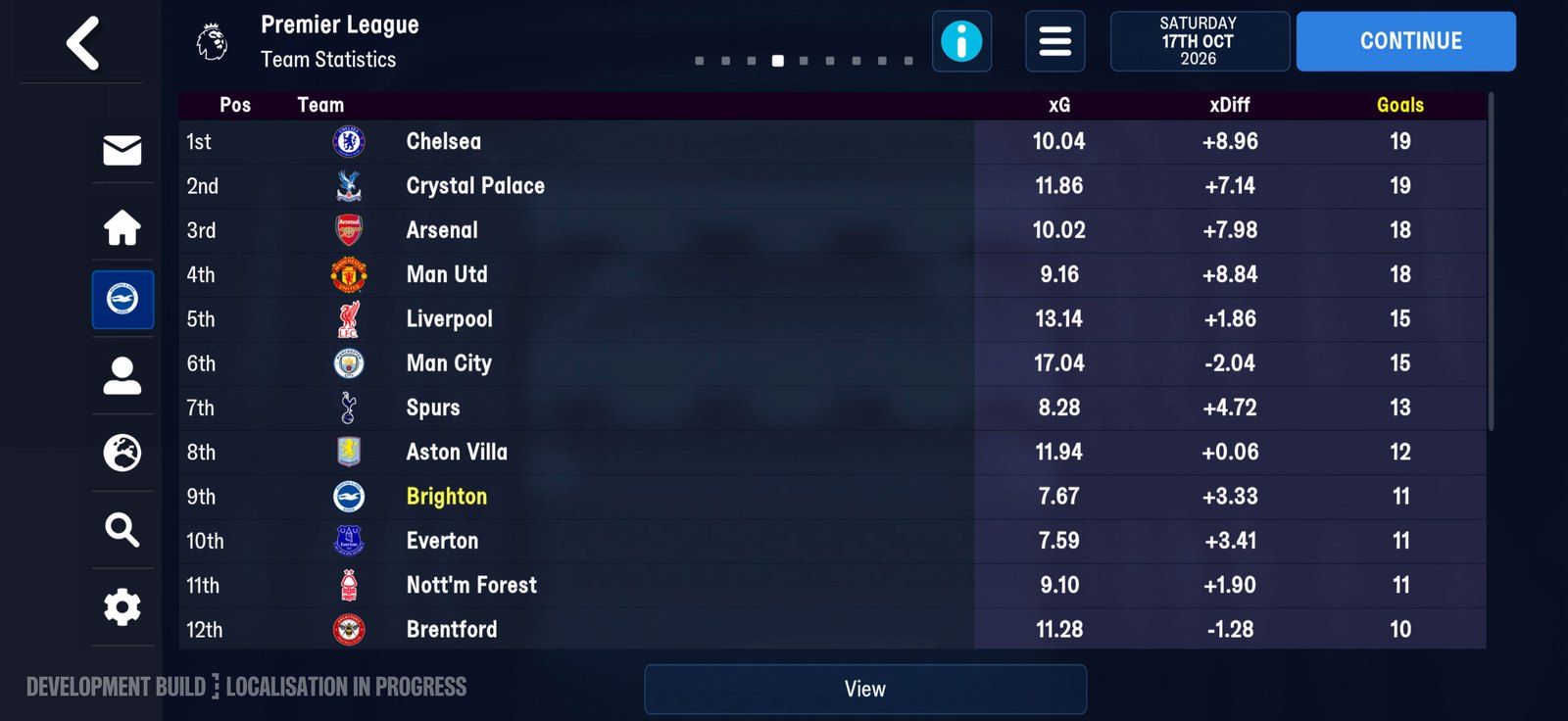
The Expected Goals column in a league table. Official screenshot, SEGA feature blog, 5 November 2026.
The three named surfaces
During the match, the blog and both FAQs put the number on the match itself. The Out Now post says real-time statistics, with Expected Goals as the example. So if you are in a highlight and you want the named stat, you look while the match is running, not only on a summary screen afterwards. League tables are the second place the blog names. A table column is a season view, not a single shot. The blog does not say the column is on every competition's table. It says league tables. If you cannot see it in a cup view, that absence is not something this site will explain with a rule it does not have. Post-match reports are the third place. That is after the final whistle, in the report, not in a social feed. The FAQ's "media items" may overlap that report. It may also mean inbox stories. The FAQ does not spell the overlap out. Both phrases stay.
What they say the number is for
The blog gives the use in one breath. Expected Goals is there so you can see whether the team created the chances it should have. That makes it easier to tell a side that was outplayed from a side whose forwards had a bad day in front of goal. It is a reading aid. It is not a target, not a wage input, and not a formation bonus. No post gives a "good" Expected Goals figure for a league. A development-build screenshot on the blog shows a sample match with numbers on it. Those numbers belong to that frame. They are not a benchmark.
What you do
Play or replay a match. Find the Expected Goals line while it is live. After the match, open the post-match report and see whether the same idea is there. Then open a league table and look for the column. If one of those three is missing on your save, the posts do not give a toggle to turn it on. They say the surfaces exist. A missing column is a support question, not a hidden slider this site will name.
| Surface | Named by |
|---|---|
| During the match | blog, both FAQs, Out Now post |
| League tables | feature blog |
| Post-match reports | feature blog |
| Other key game areas and media items | FAQ, not itemised |
Named places only
The FAQ adds a wider line. It does not invent the rest. The match block around it is on the match engine page.
Live, while it runs
A summary screen afterwards is not the only look they described. Real-time means the match is still going.
League tables, not every cup
Do not promote a cup table into the sentence they wrote. Do not demote the league table either. They named league tables. Stop there.
After the whistle
Post-match reports are the remaining place in the three named surfaces. Overlap is not a licence to draw a menu. Leave "media items" as the FAQ left it. Leave "post-match reports" as the blog left it.
A reading aid
A frame number is not a bar your team has to clear.
Three surfaces, no toggle
A missing column is a support question, not a hidden slider this site will name. Do not hunt a switch the posts never wrote.
Reading it without a benchmark
The metric answers one question: did the team create the chances it should have. That is narrower than it sounds, and it is worth being precise about what it cannot tell you. It cannot tell you whether the performance was good in the abstract. A side can create the chances and lose. A side can create nothing and win on one touch. The blog's own framing is a comparison between the chances created and the goals, which is a description of the gap, not a grade for the display. It cannot tell you what number to aim for. No post prints a target, a league average, or a band that separates a good match from a bad one. The sample match in the development-build screenshot has numbers on it because it is a frame with a scoreline in it. Treating them as a standard is inventing a benchmark the companies did not publish. It cannot tell you what to change. If the chances were there and the goals were not, the metric has done its job by showing you that. Whether the fix is the forward, the supply, or the shape is a judgment the number leaves entirely to you. It is a reading aid, in the blog's own phrase, and a reading aid is not a recommendation. The one thing it does well is separate two matches that look identical in the scoreline. A comfortable win and a lucky one can read the same in the result and differently in the chances. That separation is what the posts put the number on the phone for.