
Four parts of the physio report
Read condition, assessment, advice, and recommendations before you select.
Before you pick the side, open the physio report. Football Manager 27 Mobile added it for injury risk and match readiness. Out Now calls it a full assessment of injury risks and match readiness, so you can select the side that meets the moment. The feature blog calls it a detailed assessment of those two things, so you understand the risks before the next move. The FAQ says a more granular assessment when a player picks up an injury, including whether that player can be considered for selection, plus fatigue and match load. Three posts. One report. No recovery clock in any of them. If you came here for a number of days, the posts did not print one. Read the report on the player you are holding. Do not borrow a return date from a different season's habit.
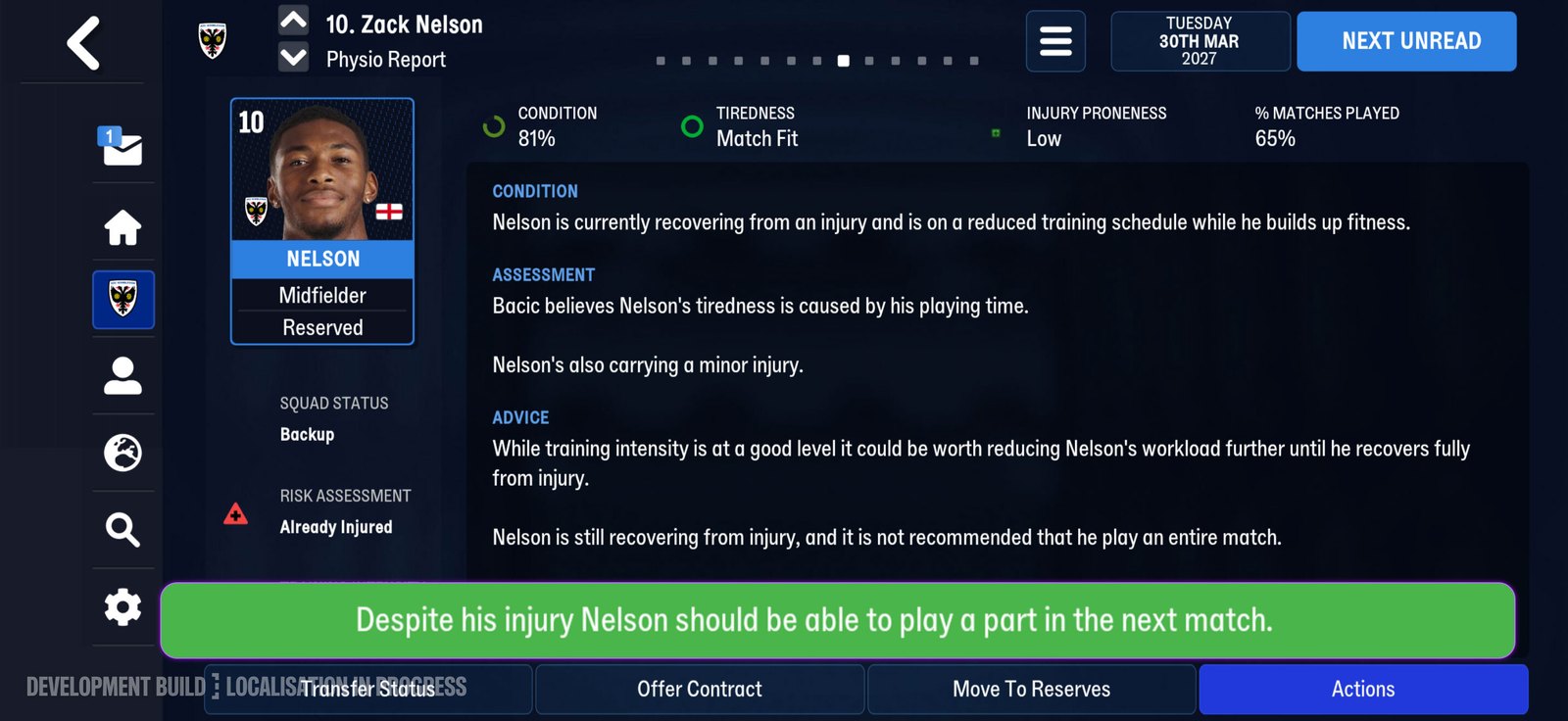
The physio report. Official screenshot, SEGA feature blog, 5 November 2026.
Four sections
The feature blog is the text that names the sections. Condition. Assessment. Advice. Recommendations. Four. In that order in the sentence. The FAQ does not repeat the four names. It describes the job: a granular assessment, advice on whether the player can be considered, and fatigue and match load to consider. Out Now names the report and the two outcomes, risk and readiness. It does not rename the sections. Use the blog's four when you are looking for headings. Use the FAQ when you are looking for the selection question. Condition is the state. The blog does not define the word beyond the section name. It says the report explains why a player may be at risk and what is contributing to their current condition. So condition is where that current state is meant to be readable. Assessment is the judgement on the risk.
The factors they named
The blog says the report combines factors. Injury history. Fitness. Fatigue. Match load. Those four are the inputs they printed. The FAQ repeats two of them in its own sentence: fatigue, and match load. It also ties the report to an injury the player has picked up. The blog's factors include history, not only the injury in front of you. A player can be a risk because of what already happened, not only because of the knock this week. That is as far as "injury history" goes. No post lists the old injuries that count. No post says a knock from three seasons ago is ignored. Fitness is a factor. It is not defined as a percentage. Fatigue is a factor. It is not defined as a colour. It is not defined as a count of minutes. If the report on your phone shows a number next to one of those words, that number is the report's number. It is not a number these posts published, so it is not copied here. "May" is in the sentence. A heavy match load does not, by itself, get turned into a certain injury by this page. The report is there so you can see the combination. Read all four factors when the report shows them. Do not stop on fatigue and ignore history, or the other way around.
| Section in the blog | What that post attaches to it | Factor named beside the report |
|---|---|---|
| Condition | Current state, and what is contributing | Fitness is one named factor |
| Assessment | Why a player may be at risk | Injury history is one named factor |
| Advice | The steer before you move | Fatigue is named in the blog and the FAQ |
| Recommendations | Selection, and training intensity | Match load is named in the blog and the FAQ |
The table follows the blog's pairing of sections with the job, and the factors with the report. It does not claim each factor lives in only one section. The posts did not draw that map. They said the report combines the factors, and that it breaks into four sections.
Selection, and how hard you train
Recommendations on selection are the call for the next match. The FAQ says the report advises on whether the player can be considered for match selection. Considered is not "starts." It is not "leave him out." It is whether he can be in the conversation. You still pick the side. The blog says the tools give context without taking the decision away. Training intensity is the other recommendation. The blog says you weigh potential short-term gains against longer-term risks, and then you make the call. The FAQ says suggestions for training and its intensity help you manage the squad over a season, next to selection insight for the upcoming match. So one horizon is the next match. The other is the season. The posts do not say which horizon wins. They say both are in the advice. That training line is not the trait button.
Risk is not a return date
Readiness is whether the player is ready for a match, in the words they used. Risk is the chance of an injury problem, in the words they used. Neither word arrived with a calendar. The blog does not say "out for" a span of time. The FAQ does not say the granular assessment includes a countdown. Out Now does not add one. A screenshot on the blog is a development frame. If your report shows a date, that date belongs to the player on the screen. It is not a rule for the next player, and it is not a rule this page will generalise. The published job is to explain the risk and the condition, then recommend on selection and intensity. Use that job. Do not add a rehab ladder the posts did not write.
Where this sits on a match day
The match itself is a different screen. The 2D engine, the graphs between highlights, and Expected Goals are about the game you are watching or have just played. They do not replace the physio report. A bad day in front of goal is a match-stat story in the feature blog. It is not an injury story. Do not open the physio report to explain a miss. Open it to explain risk, readiness, fatigue, and load. The match pages are the match engine and Expected Goals. After the match, match load is one of the factors. The posts do not say the report rewrites itself only on a Monday. They say the factors include match load, and that selection advice is there for the upcoming match. Check the report when you are about to pick, not only when a dramatic knock arrives.
On a save you already had
If you continued from Football Manager 24 Mobile or Football Manager 26 Mobile, the career is the one you loaded. The tech FAQ says those saves should appear under Load Game, and that tactics and training setups carry. It does not say old injury notes are reprinted as this season's four sections. The physio report is a new report in the posts about this season. Open it on the players you are about to pick. The load rules are on saves that carry. A new career gets the same report. The posts do not say the four sections are only for people who have played the phone game before. Out Now lists the reports among the season's additions. The blog puts them in the support tools, next to tactics guidance for people picking the phone game up for the first time.
What you do tonight
Open the player. Open the physio report. Read condition, then assessment, then advice, then recommendations, if those headings are what you see. Check injury history, fitness, fatigue, and match load if the report is showing the factors. Read whether he can be considered. Read the intensity steer. Then make the call. Write down nothing about a return date unless the report itself printed one for that player. Sources: Feature blog, 5 November 2026. Community FAQ. Out Now, 10 November 2026.